Thursday, 24 July 2014

Attackers raid SWISS BANKS with DNS and malware bombs

Attackers suspected of residing in Russia are raiding Swiss bank accounts with a multi-faceted attack that intercepts SMS tokens and changes domain name system settings, researchers have warned.
The attacks sported a clever implementation of malware that pointed victim machines to replica phishing bank sites when they attempt to access their accounts without triggering any warnings.
That tactic was accomplished by malware that manipulated a victims' DNS settings and installed an SSL certificate for the phishing sites before wiping itself clean to remove evidence of infection.
Users who fell for the email campaign and subsequently installed the malware would be prompted to install an Android app to purportedly secure their banking transactions, but which would serve to steal second factor SMS tokens and furry it off to an attackers' command and control server or mobile phone number.
SWITCH CH engineer Daniel Stirnimann (@seckle_ch) said the "Retefe" banking trojan, as the attack is known, is impressively simple.
"After infection, the installation routine deletes itself from the compromised system which makes it difficult for anti-virus programs to detect the infection," Stirnimann wrote.
"The malware has an elegance that is difficult to beat: It does away with the [downloaded] software components and thus minimizes the complexity. It also seems that there is now an economic point of view from scammers to infect new victims simply PCs via spam campaigns."
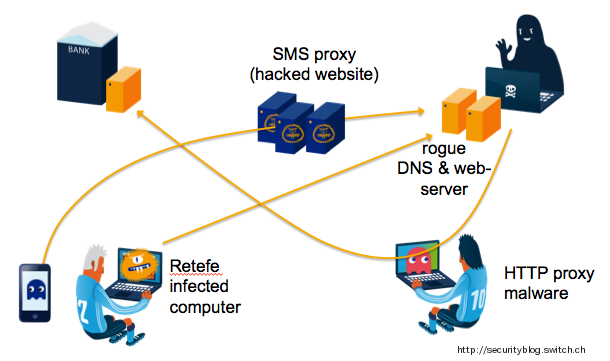
Retefe schematics Retefe schematics: SWITCH.CH
The Android software also stole a victim's mobile transaction authentication number, used for second factor authentication by European banks including those operating in Australia and New Zealand.
Stirnimann said scarcely-used mobile anti-virus tools should detect the application.
With the token in hand, attackers had "full control" of victim bank accounts which the logged in with a hacked local computer to avoid triggering anti-fraud mechanisms.
Researchers David Sancho, Feike Hacquebord and Rainer Link of security firm Trend Micro also pried apart the malware which they said in a report was the work of Russians using the handles -=FreeMan=- and Northwinds who have been active black hats since 2011.
Trend Micro dubbed the malware campaign "Emmental" after the delicious and hole-ridden Swiss cheese.

50,000 sites backdoored through shoddy WordPress plugin

Some 50,000 sites have been sprayed with backdoors from shonky malware targeting a popular and vulnerable WordPress plugin, according to researcher Daniel Cid.
Sucuri founder Cid says the bodged malware can infect any site that resides on the server of a hacked WordPress website. The flawed plugin allowed attackers to "inject anything" into sites including malware, defacements and spam.
"The malware code had some bugs: it was breaking many websites, overwriting good files and appending various statements in loops at the end of files," Cid said in a blog.
"All the hacked sites were either using MailPoet or had it installed on another sites within the same shared account -- cross-contamination still matters.
"To be clear, the MailPoet vulnerability is the entry point, it doesn't mean your website has to have it enabled or that you have it on the website; if it resides on the server, in a neighbouring website, it can still affect your website."
Cid urged WordPress sites to update their vulnerable plugins.
Admins could look for an obvious sign of infection with the error: "Parse error: syntax error, unexpected ‘)’ in /home/user/public_html/site/wp-config.php on line 91". More technical detail was available on the Sucuri blog.