A computer virus which has hit City Power has resulted in a blackout to its internet technology system, leaving scores of Johannesburg residents unable to purchase electricity, as their kilowatts approach 0.00.
The power utility’s spokesperson Isaac Mangena said the virus had attacked its database and other software, impacting on most of its applications and networks.
The virus has also prevented those who had already bought their electricity from uploading it to their meter boxes.
The City Power website is also affected by the virus.
"It may also affect our response to some outages, as the system to order and dispatch material is affected. City Power IT team has been working since early morning 01:00 to fix this problem," Mangena said.
He said they hoped to have the glitch fixed by midday on Thursday.
On Wednesday, the utility announced that it was experiencing capacity constraints due to the cold weather in Johannesburg.
Mangena said cold weather conditions could result in unplanned outages, as the electrical system experienced overloading when demand increased.
He said plans were in place to deal with unplanned outages. The key focus of the plan was to attend to those areas that experienced repeated unplanned outages on the same day or week, he said.
"We have also increased the number of technicians in areas that are prone to repeated unplanned power outages.
"More teams have been put on standby so that they can be dispatched to attend to outages and respond to emergency calls," he said.
Residents have been urged to use electricity sparingly during this time.
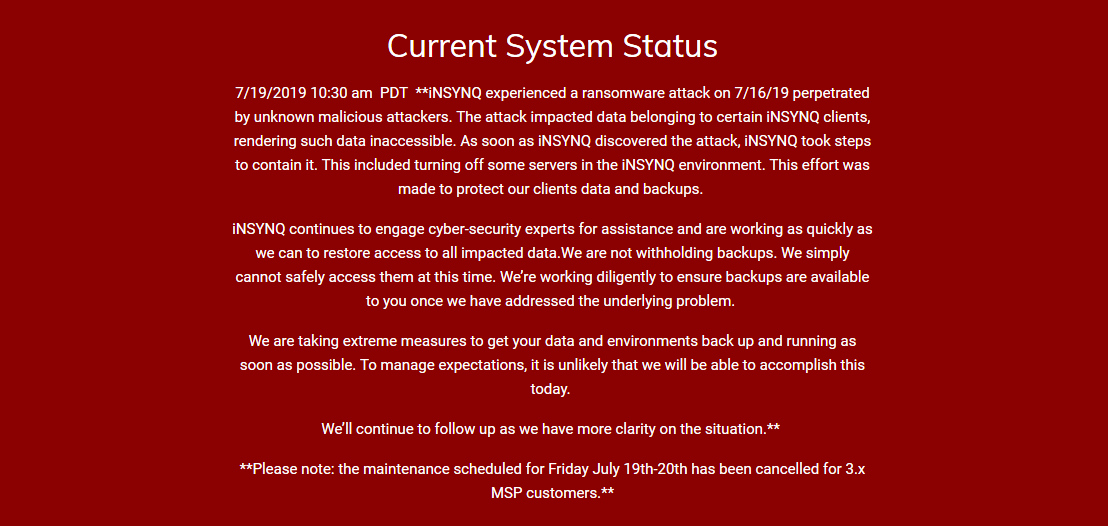
Cloud computing provider iNSYNQ experienced a ransomware attack which forced the company to shut down some of its servers to contain the malware infection from spreading and affecting more customer data.
iNSYNQ is an authorized Microsoft, Intuit, and Sage host which provides customers with cloud-based virtual desktops designed to host business applications such as QuickBooks, Sage, Act & Office.
"iNSYNQ experienced a ransomware attack on 7/16/19 perpetrated by unknown malicious attackers. The attack impacted data belonging to certain iNSYNQ clients, rendering such data inaccessible," says a status update published on the company's support website.
"As soon as iNSYNQ discovered the attack, iNSYNQ took steps to contain it. This included turning off some servers in the iNSYNQ environment. This effort was made to protect our clients data and backups.
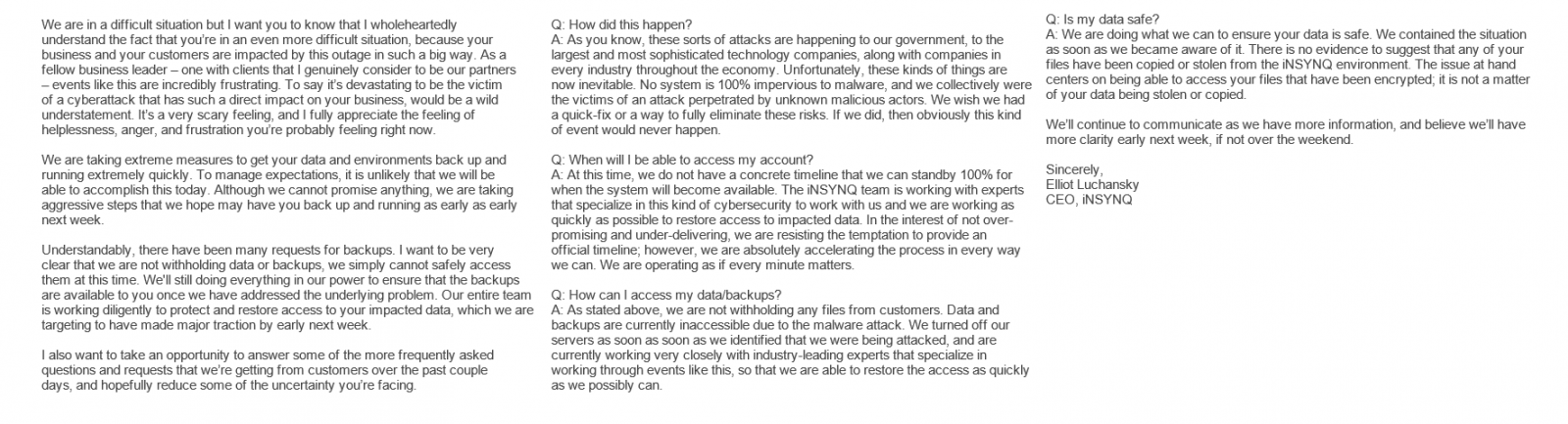
The cloud hosting firm also says that it has hired cybersecurity experts to help restore access to affected customer data and to all clients' virtual desktops, with "major traction" to be made "by early next week" according to a letter sent to customers by iNSYNQ's CEO.
As iNSYNQ's CEO Elliot Luchansky also added in his letter, "Understandably, there have been many requests for backups I want to be very clear that we are not withholding data or backups, we simply cannot safely access them at this time.
"We'll still doing everything in our power to ensure that the backups are available to you once we have addressed the underlying problem. Our entire team is working diligently to protect and restore access to your impacted data [..]"
Luchansky also answered some of the questions asked by iNSYNQ's customers following the downtime caused by the ransomware attack stating that:
Unfortunately, these kinds of things are inevitable. No system is 100% impervious to malware, and we collectively were victims of an attack perpetrated by unknown malicious actors. We wish we had a quick-fix or a way to fully eliminate these risks. If we did, then obviously this kind of event would never happen.
He also said that a timeline for when the customers' environments will be back up is not yet available but the iNSYNQ team is accelerating the process of restoring the clients' data and getting all systems online.
"We turned off servers as soon as we identified that we were being attacked, and are currently working very closely with industry-leading experts that specialize in working through events like this, so that we are able to restore the access as quickly as we possibly can," added Luchansky.
"We contained the situation as soon as we became aware of it. There is no evidence to suggest that any of your files have been copied from the iNSYNQ environment. The issue at hand centers on being able to access your files that have been encrypted; it is not a matter of your data being stolen or copied," iNSYNQ's CEO also said.
While the letter sent by the CEO to the company's customers after the security incident provides some extra info on what happened, there is no mention of the ransomware attack that hit iNSYNQ on Luchansky's Twitter account or on the iNSYNQ account that is no longer accessible — a Google-cached version of the account's contents can be found here).
A customer who got in touch with the iNSYNQ team says that the clients' data backups were stored on a separate server but on the same network affected by the cyber-attack.
The company also believes that all the customer data will be recovered and restored but it will take some time until all the backups will be checked to make sure that the malware did not affect them in any way.