 On May 9, 2012, cyber crooks hit Wallace & Pittman PLLC,
a Charlotte, N.C. based law firm that specializes in handling escrow
and other real-estate legal services. The firm had just finished a real
estate closing that morning, initiating a wire of $386,600.61 to a bank
in Virginia Beach, Virginia. Hours later, the thieves put through their
own fraudulent wire transfer, for exactly $50,000 less.
On May 9, 2012, cyber crooks hit Wallace & Pittman PLLC,
a Charlotte, N.C. based law firm that specializes in handling escrow
and other real-estate legal services. The firm had just finished a real
estate closing that morning, initiating a wire of $386,600.61 to a bank
in Virginia Beach, Virginia. Hours later, the thieves put through their
own fraudulent wire transfer, for exactly $50,000 less.At around 3 p.m. that day, the firm’s bank — Charlotte, N.C. based Park Sterling Bank (PSB)– received a wire transfer order from the law firm for $336,600.61. According to the bank, the request was sent using the firm’s legitimate user name, password, PIN code, and challenge/response questions. PSB processed the wire transfer, which was sent to an intermediary bank — JP Morgan Chase in New York City — before being forwarded on to a bank in Moscow.
Later that day, after the law firm received an electronic confirmation of the wire transfer, the firm called the bank to say the wire transfer was unauthorized, and that there had been an electronic intrusion into the firm’s computers that resulted in the installation of an unspecified strain of keystroke-logging malware. The law firm believes the malware was embedded in a phishing email made to look like it was sent by the National Automated Clearing House Association (NACHA), a legitimate network for a wide variety of financial transactions in the United States.
As some banks do in such cases, Park Sterling provided a provisional credit to the firm for the amount of the fraudulent transfer so that it would avoid an overdraft of its trust account (money that it was holding for a real estate client) and to allow a period of time for the possible return of the wire transfer funds. PSB said it informed Wallace & Pittman that the credit would need to be repaid by the end of that month.
But on May 30, 2012 — the day before the bank was set to debit the loan amount against the firm’s trust account — Wallace & Pittman filed a complaint against the bank in court, and obtained a temporary restraining order that prevented the bank from debiting any money from its accounts. The next month, the law firm drained all funds from all three of its accounts at the bank, and the complaint against the bank was dismissed.
Park Sterling Bank is now suing its former client, seeking repayment of the loan, plus interest. Wallace & Pittman declined to comment on the ongoing litigation, but in their response to PSB’s claims, the defendants claim that at no time prior to the return of the funds did the bank specify that it was providing a provisional credit in the amount of the fraudulent transfer. Wallace & Pittman said the bank didn’t start calling it a provisional credit until nearly 10 days after it credited the law firm’s account; to backstop its claim, the firm produced an online ledger transaction that purports to show that the return of $336,600.61 to the firm’s accounts was initially classified as a “reverse previous wire entry.”
 Java 7 Update 21 contains
  Java
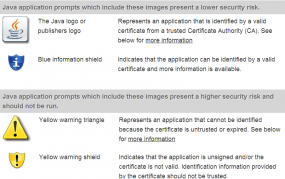
7 Update 21 also introduces some new security warnings and message
prompts for users who keep the program plugged into a Web browser (on
installation and updating, Java adds itself as an active browser
plugin). Oracle
Java
7 Update 21 also introduces some new security warnings and message
prompts for users who keep the program plugged into a Web browser (on
installation and updating, Java adds itself as an active browser
plugin). Oracle