As the whistleblowing NSA sysadmin Edward Snowden made his dramatic
escape to Russia a year ago, a secret US government jet - previously
employed in CIA "rendition" flights on which terror suspects disappeared
into invisible "black" imprisonment - flew into Europe in a bid to
spirit him back to America, the
Register can reveal.
On the evening of 24 June 2013, as Snowden arrived in Moscow from
Hong Kong intending to fly on to Cuba, an unmarked Gulfstream V business
jet - tail number N977GA - took off from a quiet commercial airport 30
miles from Washington DC. Manassas Regional Airport discreetly offers
its clients "the personal accommodations and amenities you can't find at
commercial airports".
Early next morning, N977GA was detected
heading east over Scotland at the unusually high altitude of 45,000
feet. It had not filed a flight plan, and was flying above the level at
which air traffic control reporting is mandatory.
"The plane
showed up on our system at 5:20 on 25 June," according to our source, a
member of an internet aircraft-tracking network run by enthusiasts in
the UK. "We knew the reputation of this aircraft and what it had done in
the past."
N977GA was not reporting its progress to air-traffic
controllers, and thus it would normally have been necessary to use a
massive commercial or military radar installation to follow its path.
But, even if pilots have turned off automated location data feeds,
ordinary enthusiasts equipped with nothing more than suitable radio
receivers connected to the internet can measure differences in the time
at which an aircraft's radar transponder signal reaches locations on the
ground. Using the technique of
multilateration,
this information is sufficient to calculate the transponder's position
and so track the aircraft. (The ACMS/ACARS data feeds which
automatically report an aircraft's position are a separate system from
the transponder which responds to air-traffic radar pulses. They too can
be picked up by receivers on the ground beneath, if they are
activated.)
Several such online tracking networks are active in
the UK, using this and other sources of information: they include
www.flightradar24.com, www.planefinder.net, Planeplotter
(www.coaa.co.uk/planeplotter.htm) and www.radarvirtuel.com. UK-based
Planeplotter is one of the more sophisticated of these global "virtual
radar" systems. It boasts 2,000 members with receivers hooked up to the
internet.
The online tracking information reveals that the
Gulfstream did not make it all the way to Moscow, but set down and
waited at Copenhagen Airport.

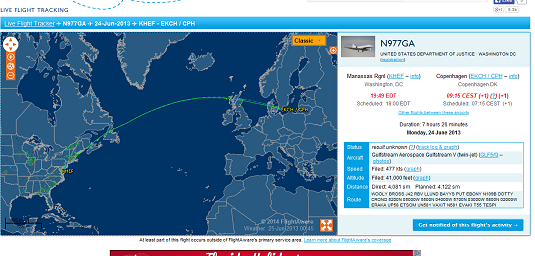 Mr Snowden, your ride is waiting.